A Decline Code Is Not a Diagnosis
How payment responses lose meaning across gateways, processors, networks, and merchant systems.
How payment responses lose meaning across gateways, processors, networks, and merchant systems
A card-not-present authorization fails.
The merchant receives:
do_not_honorThat appears to be an explanation.
It is not.
It may be the gateway’s translation of a processor response. The processor response may itself be a normalized representation of a network message. The network message may contain a generic response selected by the issuing financial institution, by the network acting on the issuer’s behalf, or by an intermediary unable to preserve the original detail.
By the time the merchant sees do_not_honor, the response may have passed through several systems, each applying its own vocabulary and interpretation.
The merchant is left with a value that looks precise but may mean little more than:
The authorization was not approved, and no more specific reason is available here.
This is not limited to do_not_honor.
Payment gateways expose proprietary response codes, statuses, decline reasons, processor messages, error types, and human-readable descriptions. Some preserve the underlying network or acquirer response. Others translate it. Some expose both. Others collapse multiple upstream conditions into one merchant-facing category.
Merchants then add another translation layer by converting these responses into internal concepts such as:
soft_decline
hard_decline
processor_error
Each translation makes the response easier to consume.
Each translation can also remove information.
A decline code is therefore not a diagnosis. It is one piece of evidence produced by a chain of systems.
This is the companion problem to the one described in Authorization Is Not Approval: a payment outcome is only meaningful when the system, stage, and denominator behind it are explicit.
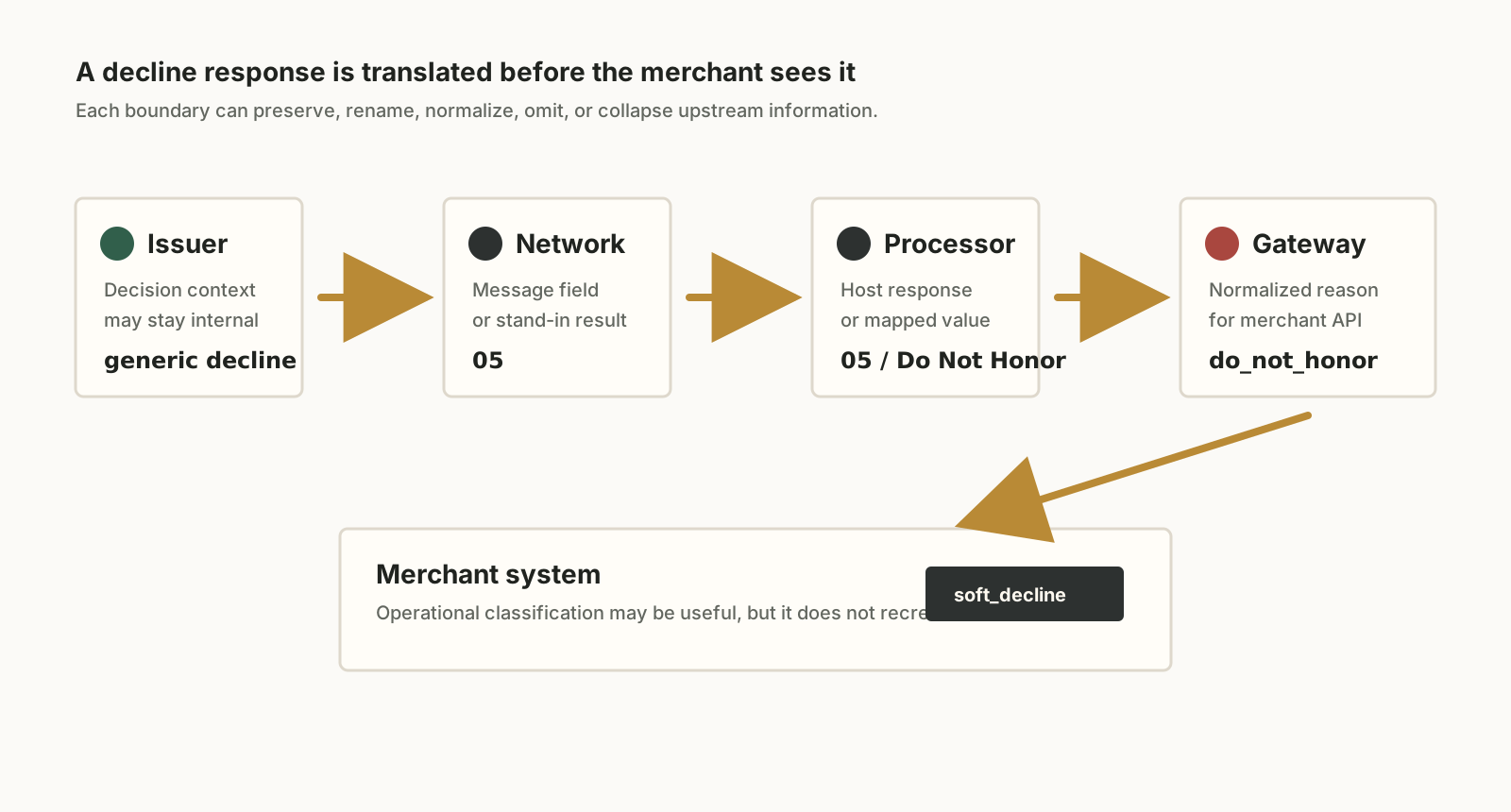
The merchant-facing decline reason may be several translations away from the original decision.
The merchant does not receive one response code
It is common to refer to “the response code” as though every failed authorization produces a single authoritative value.
In practice, one payment attempt may produce several distinct response fields:
- A top-level transaction status
- An API error type
- A gateway-specific response code
- A normalized decline reason
- A processor response code
- A network response code
- A processor response message
- Raw acquirer data
- A merchant-defined internal classification
These fields are not interchangeable.
A top-level status answers a question such as:
Did the gateway consider this payment successful?
A decline reason attempts to answer:
How did the gateway categorize the failure?
A raw processor or network code may answer:
What response did the downstream system return?
An internal merchant classification answers:
How does our organization want to group this outcome?
Those are different questions.
Consider a simplified response model:
{
  "status": "failed",
  "error_type": "card_error",
  "decline_code": "do_not_honor",
  "processor_code": "05",
  "merchant_classification": "soft_decline"
}
The five values describe five different layers of interpretation.
failed is an outcome.
card_error is an API-level error category.
do_not_honor is a normalized gateway reason.
05 is a downstream response that may have originated with an issuer, network, or processor.
soft_decline is an operational classification assigned by the merchant or one of its providers.
None of these values, standing alone, explains exactly why the issuing financial institution rejected the transaction.
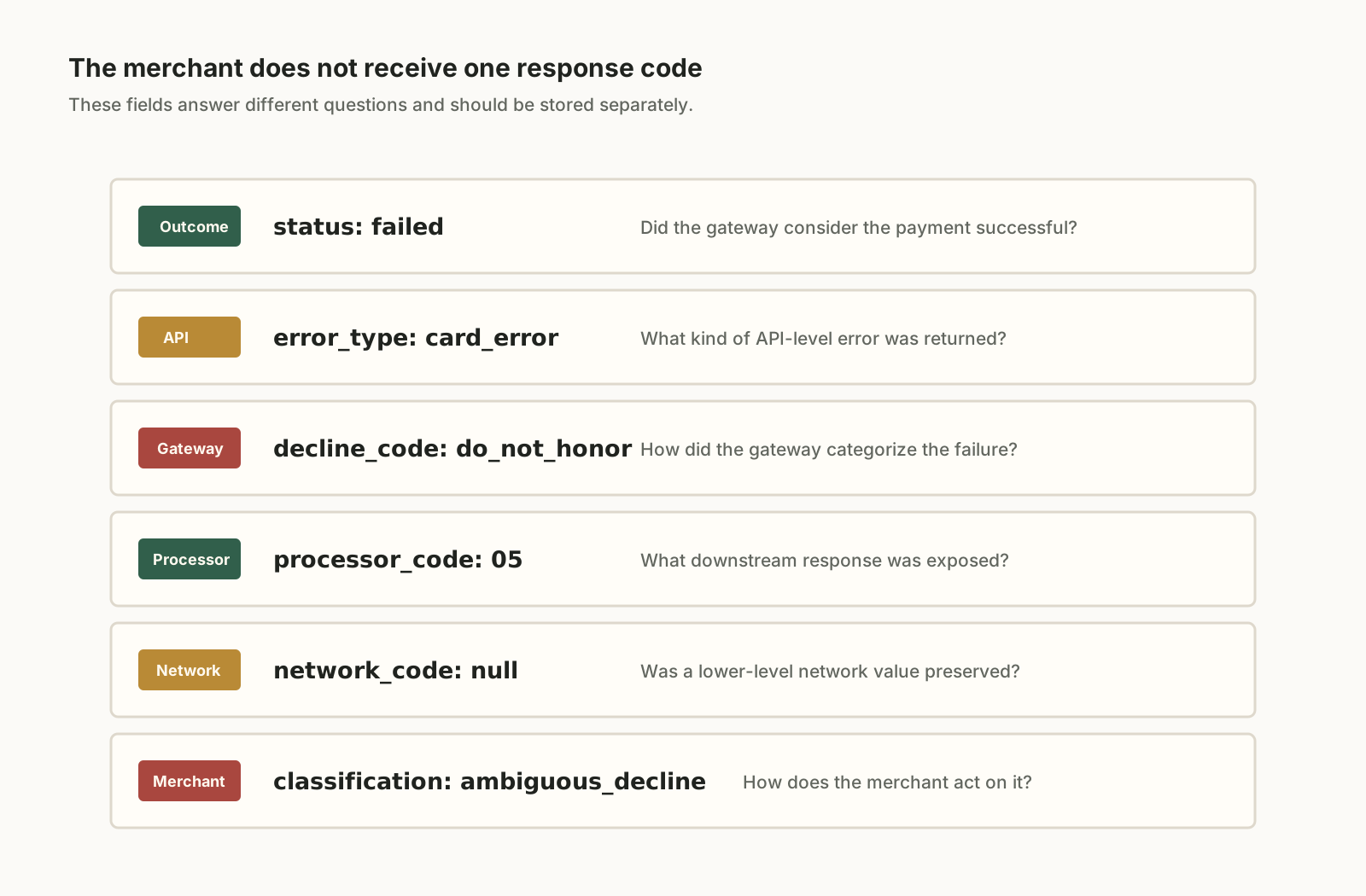
A useful response model preserves each layer instead of forcing them into one field.
Begin with 05: Do Not Honor
05 is among the best-known authorization response codes.
Its traditional description is:
Do Not HonorThat wording sounds definitive. It is actually one of the least diagnostic responses a merchant can receive.
A 05 response does not necessarily identify a specific defect in the payment request, a specific account condition, or a specific risk decision. It communicates that the transaction was declined without exposing a more precise reason through that response.
The actual issuer-side cause may involve fraud controls, account restrictions, transaction characteristics, internal policy, unavailable context, or a condition the issuer does not intend to disclose.
The merchant cannot reliably reverse-engineer that decision from 05.
The ambiguity exists before the response reaches the gateway.
The payment path can then compound it.
A simplified flow can be shown as a translation path:
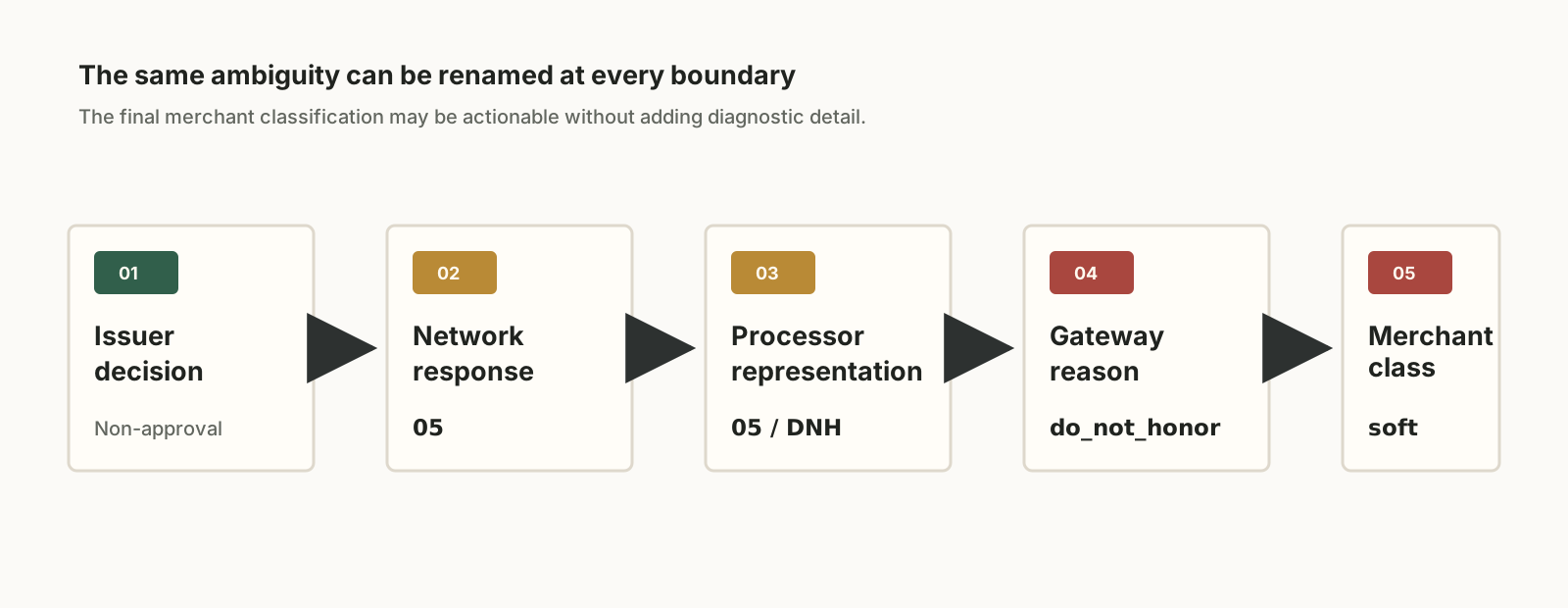
The merchant classification may be actionable without adding diagnostic detail.
The final classification may look actionable, but no new diagnostic information was created along the way.
The systems only renamed the same ambiguity.
The path from issuer response to merchant response
A merchant commonly thinks of the authorization response as travelling directly from the issuer back to its application.
The actual return path is closer to:
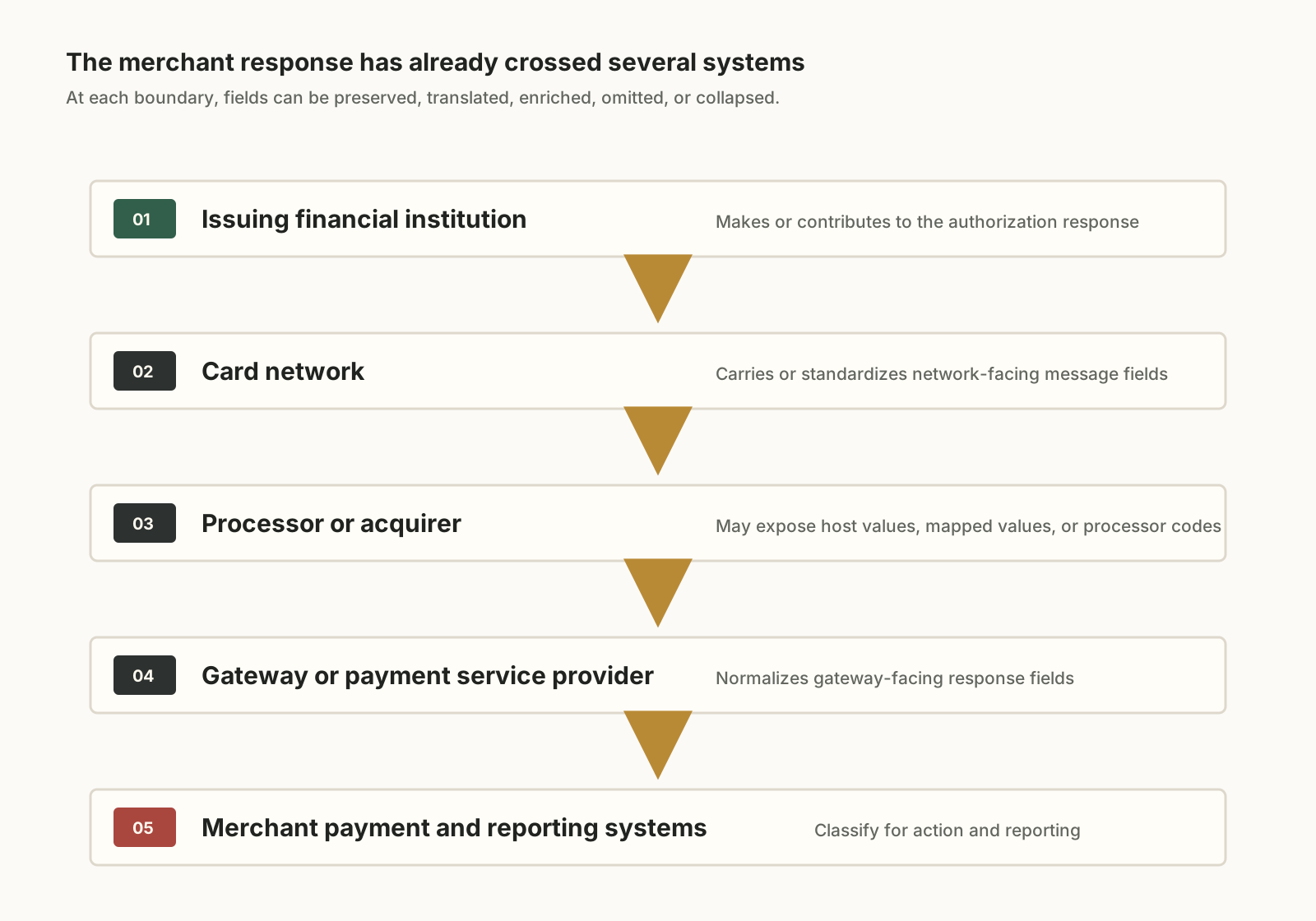
The response can be translated before it reaches the system that stores or reports it.
At each boundary, several things may happen:
- The response may be passed through unchanged.
- It may be converted into a different code set.
- It may be mapped into a normalized category.
- Additional fields may be attached.
- Fields may be omitted.
- Several upstream responses may be collapsed into one value.
- The response may be reclassified as soft, hard, or erroneous.
- A technical failure may replace the expected authorization response entirely.
The response that finally reaches the merchant is therefore not necessarily the response generated at the beginning of the return path.
It is the result of a translation pipeline.
ISO-style codes are only one layer
Many payment professionals describe issuer and network outcomes using familiar two-digit values:
| Code | Common description |
|---|---|
05 |
Do not honor |
14 |
Invalid account number |
51 |
Insufficient funds |
54 |
Expired card |
57 |
Transaction not permitted |
61 |
Exceeds amount limit |
62 |
Restricted card |
65 |
Exceeds frequency limit |
91 |
Issuer unavailable |
96 |
System malfunction |
These codes are often described loosely as ISO 8583 codes because authorization systems commonly use ISO 8583-style response fields and conventions.
That does not mean every merchant receives the same two-digit code, or that every network, processor, or issuer uses every value identically.
Even within ISO 8583, versions and implementations differ. Networks also maintain their own message specifications and response values. Processors may introduce proprietary codes, combine network responses, or expose normalized host values rather than the value received from the network.
ISO-style codes are useful for understanding the source vocabulary of authorization systems.
They are not a universal merchant API.
Only selected integrations expose something close to that source vocabulary directly.
J.P. Morgan’s current Orbital Gateway documentation, for example, distinguishes between a normalized host authorization response and the exact non-normalized response returned by its Stratus or Tandem host systems. That separation is unusually explicit: one field communicates the normalized result, while another can preserve the original host value.
Most modern gateway integrations instead present their own response model.
What the merchant actually sees
Stripe
Stripe separates several concepts.
A failed card payment may produce an API error with the general code:
card_declinedThe error can also include a more specific decline_code, such as:
do_not_honor
insufficient_funds
expired_card
generic_decline
transaction_not_allowed
Stripe explicitly describes these as Stripe-defined decline codes that cover many of the same conditions as traditional issuer codes, while using Stripe’s own vocabulary. Stripe also documents network decline codes separately and may expose advice information associated with the network response.
The merchant may therefore have access to several layers:
API error type: card_error
API error code: card_declined
Stripe decline code: do_not_honor
Network decline code: possibly available
Advice code: possibly available
A reporting system that stores only card_declined destroys most of the available distinction.
A reporting system that stores only do_not_honor retains more detail, but still should not assume it has preserved the original issuer response.
Adyen
Adyen exposes a resultCode indicating the overall payment outcome and a refusalReason explaining how Adyen classified an unsuccessful payment.
For example:
resultCode: Refused
refusalReason: Not enough balance
or:
resultCode: Error
refusalReason: Acquirer Error
Adyen explains that raw acquirer responses are mapped into its standardized refusal reasons. That normalization allows merchants to work with one vocabulary across payment methods and acquiring connections.
Adyen can also expose raw acquirer fields such as:
refusalReasonRaw
refusalCodeRaw
Availability depends on the payment method, card network, configuration, and data returned by the downstream participant.
The merchant-facing model can therefore contain both:
Adyen interpretation: Not enough balance
Raw response: 51
Those fields should be preserved separately.
Checkout.com
Checkout.com exposes a five-digit response_code as the primary payment response in its Unified Payments API and payment webhooks. Additional context is provided through fields such as response_summary and status.
Its codes are divided into broad categories:
10xxx = approved
20xxx = soft decline
30xxx = hard decline
40xxx = risk response
Within many 20xxx payment responses, the final two digits preserve the corresponding two-digit processor or network response.
For insufficient funds, the merchant receives:
{
  "response_code": "20051",
  "response_summary": "Insufficient funds"
}
The relationship is visible:
51 -> 20051That makes Checkout.com’s translation easier to inspect than a gateway vocabulary that replaces the source value entirely.
The prefix still adds Checkout.com’s interpretation.
20051 does not merely represent response 51. It also places the transaction inside Checkout.com’s soft-decline category.
Several nearby responses illustrate why merchants should preserve the complete code rather than collapsing them all into an insufficient_funds bucket:
| Checkout.com code | Underlying code | Response |
|---|---|---|
20005 |
05 |
Do not honour |
20051 |
51 |
Insufficient funds |
20061 |
61 |
Exceeds withdrawal amount limit |
20065 |
65 |
Exceeds withdrawal frequency limit |
All four may be treated operationally as soft declines, but they do not describe the same condition.
20051 indicates a balance or credit availability problem.
20061 indicates an amount ceiling.
20065 indicates a frequency or velocity ceiling.
20005 is the generic case. It may conceal several issuer-side reasons, including conditions that another issuer or processor might have represented more specifically.
Collapsing these responses into one recovery category may simplify downstream logic, but it removes distinctions present in the gateway response itself.
Braintree
Braintree exposes a particularly clear example of layered classification.
A transaction can contain:
status
processor_response_code
processor_response_text
processor_response_type
The response type can be:
approved
soft_declined
hard_declined
Braintree maintains its own processor response code set, including values such as:
2000: Do Not Honor
2001: Insufficient Funds
2004: Expired Card
2038: Processor Declined
The Braintree code is not the same value as the familiar two-digit upstream response. Braintree has translated the processor outcome into a proprietary four-digit model and then separately classified it as soft or hard.
For one failed authorization, a merchant might store:
status: processor_declined
processor_response_code: 2000
processor_response_text: Do Not Honor
processor_response_type: soft_declined
These fields provide more structure than a single decline value.
They still do not reveal the issuer’s complete reasoning.
Worldpay
Worldpay products have evolved through multiple platforms, APIs, acquiring configurations, and integration models. Their response structures are therefore not reducible to one universal Worldpay decline code set.
Depending on the Worldpay product and integration, merchants may encounter combinations of:
- Payment outcomes
- Gateway response codes
- Refusal descriptions
- Acquirer responses
- Network responses
- Product-specific error fields
This is itself part of the problem.
A merchant should not interpret a field merely because it is called responseCode. It must identify whether that field represents an API result, a gateway-normalized payment result, an acquirer response, or a network value.
The name of the field does not establish its provenance.
Chase and Stratus-backed processing
Chase provides an instructive contrast because some of its systems expose host-oriented authorization responses more directly.
The current Orbital Gateway response model documents both:
- A normalized authorization response issued by the host system
- The exact, non-normalized authorization response sent by the Stratus or Tandem host
This makes the translation boundary visible rather than implicit.
Even a gateway that exposes lower-level host information can therefore return:
Normalized host response
Original host response
Gateway status
Response message
It is still a response model, not one response code.
The same condition can produce different merchant-facing values
Consider an issuer-side insufficient-funds condition.
At an upstream network or processor layer, it may be represented as:
51A merchant might then see something resembling:
| System | Possible merchant-facing representation |
|---|---|
| Chase or host-oriented integration | Host response related to insufficient funds, potentially with a separate normalized value |
| Stripe | insufficient_funds |
| Adyen | Not enough balance, potentially alongside raw 51 |
| Checkout.com | A Checkout.com payment response code associated with insufficient funds |
| Braintree | 2001: Insufficient Funds, classified within Braintree’s response model |
| Worldpay | A product-specific refusal or response value representing the condition |
The wording differs.
The code format differs.
The classification may differ.
The available raw detail differs.
Now consider 05: Do Not Honor.
| System | Possible merchant-facing representation |
|---|---|
| Chase or host-oriented integration | A host-specific response and message associated with do not honor |
| Stripe | do_not_honor or, depending on available detail, a more generic decline |
| Adyen | A normalized refusal reason such as Refused, with raw response data where available |
| Checkout.com | A Checkout.com response code representing a generic or issuer decline |
| Braintree | 2000: Do Not Honor, commonly accompanied by a soft-decline classification |
| Worldpay | A product-specific generic refusal or issuer-decline response |
This table should not be read as a guaranteed one-to-one mapping.
That is precisely the point.
The gateway receives whatever detail the processor or acquirer makes available, applies its own mapping rules, and exposes the result through its own API contract.
A merchant cannot safely assume:
Stripe do_not_honor
    ==
Braintree 2000
    ==
Adyen Refused
    ==
Checkout.com generic decline
    ==
Worldpay issuer declined
They may share a common upstream origin.
They may also represent different upstream conditions that have been normalized into similar merchant-facing language.
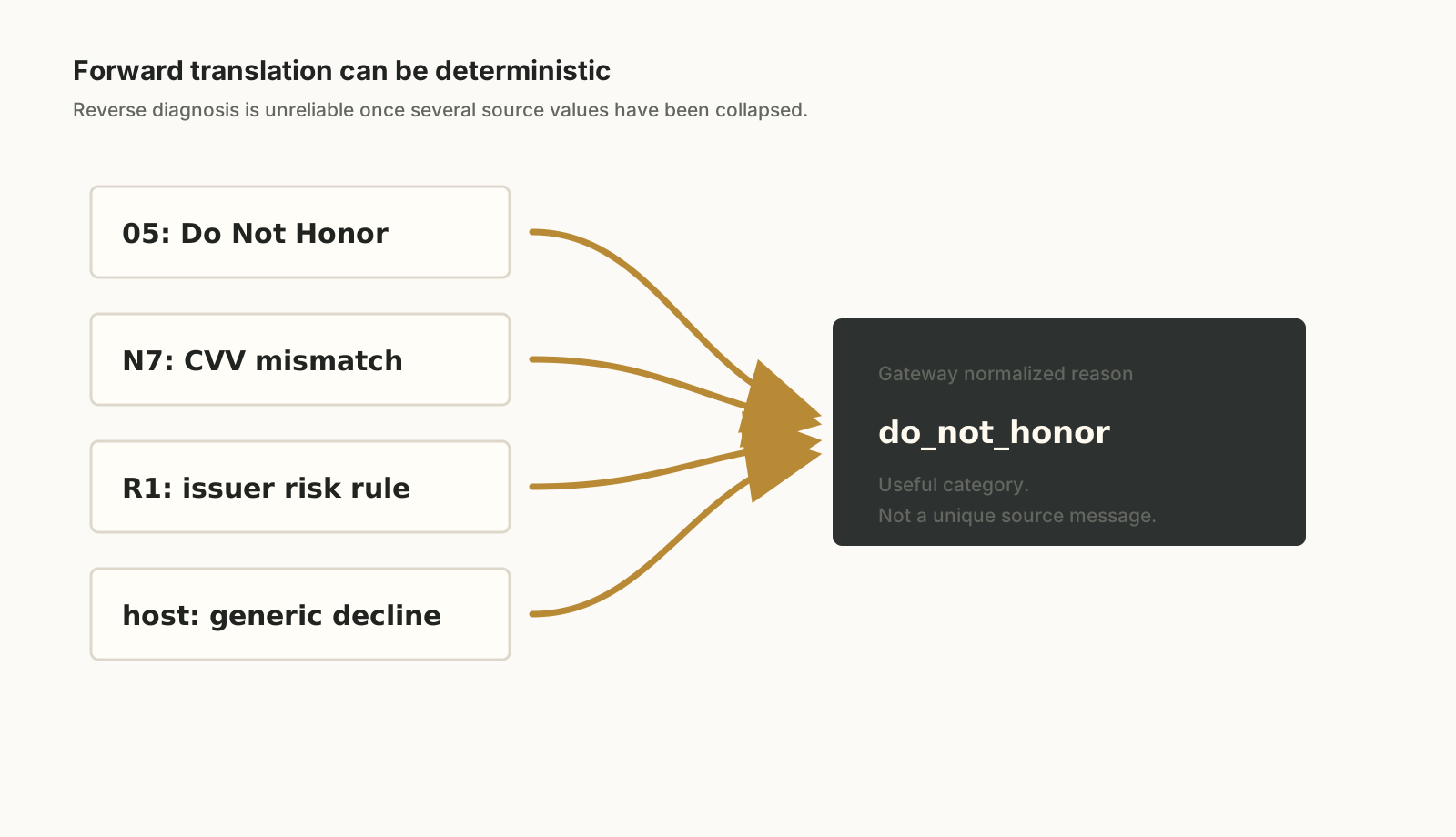
Forward mapping can be useful. Reverse diagnosis becomes unreliable after many-to-one normalization.
Forward translation is possible; reverse diagnosis is unreliable
A gateway can take an upstream code and translate it into a normalized category.
For example:
05 → do_not_honor
51 → insufficient_funds
54 → expired_card
This forward mapping is deterministic when the gateway knows the upstream value and its own mapping rules.
The reverse operation is much less reliable.
Given:
do_not_honorthe merchant cannot necessarily conclude:
The issuer returned ISO-style response 05.The gateway may use do_not_honor for several processor responses.
The processor may have created that response after receiving a different network value.
The network may have generated the response through stand-in processing.
The issuer may have supplied only a generic decline.
The merchant-facing category can indicate a family of outcomes without uniquely identifying the original message.
In information terms, the mapping is frequently many-to-one:
upstream response A ┐
upstream response B ├──> normalized gateway response
upstream response C ┘
Once those values have been collapsed, the merchant cannot reconstruct the original response unless another field preserved it.
Soft and hard declines are interpretations
Soft and hard declines are useful operational categories.
They are not universal issuer-defined facts.
A typical model describes:
soft decline = potentially recoverable
hard decline = treated as terminal without changed information
But the point at which that label is applied varies.
It may be assigned by:
- The gateway
- The processor
- A subscription billing platform
- A payment orchestration provider
- A merchant’s own payment service
- An analytics or optimization provider
The classification may therefore be:
- Gateway-specific
- Product-specific
- Merchant-specific
- Dependent on transaction context
- Dependent on whether new information can be supplied
- Dependent on network retry rules
- Dependent on the merchant’s risk tolerance
A response can be operationally soft without being diagnostically clear.
Do Not Honor is a good example.
One provider may classify it as soft because a later attempt could produce a different result. Another system may suppress further attempts based on additional network advice, attempt history, or merchant rules.
The response itself has not changed.
The interpretation has.
This is why merchants should retain the original gateway classification rather than replacing it with their own.
Instead of:
{
  "classification": "soft_decline"
}
preserve:
{
  "gateway_response_code": "2000",
  "gateway_response_text": "Do Not Honor",
  "gateway_response_type": "soft_declined",
  "merchant_classification": "ambiguous_decline"
}
The merchant can revise its own interpretation later without rewriting the historical source data.
Errors are not declines
A decline communicates that a participant made or returned a negative authorization decision.
An error communicates that something failed while the request was being processed.
Those are not equivalent outcomes.
Common error conditions include:
- Invalid API requests
- Gateway validation failures
- Authentication failures
- Processor connectivity errors
- Issuer unavailability
- Network timeouts
- Internal service failures
- Malformed responses
- Serialization failures
- Request timeouts
- Response timeouts
The distinction matters because an error may not tell the merchant whether an authorization decision occurred.
A timeout means the merchant did not receive a definitive response within the expected period.
It does not necessarily mean the issuer declined the payment.
The request may have failed before reaching the processor.
It may have reached the issuer and timed out on the return path.
It may have been approved downstream while the gateway response was lost.
It may have reached a system that could not determine the final state.
The correct technical category is often:
unknown outcomenot:
declinedCollapsing both into payment_failed makes aggregate reporting convenient, but it destroys a crucial distinction between a negative decision and a missing observation.
Common merchant-facing response classes
The exact values vary, but merchant-facing responses commonly fall into three broad classes.
Soft-decline responses
Typical examples include:
- Insufficient funds
- Exceeds withdrawal or amount limit
- Exceeds frequency limit
- Temporary issuer restriction
- Generic issuer decline
- Do not honor
- Processor decline
- Authentication required
- Issuer unavailable, when represented as a recoverable payment outcome
These responses are often described as potentially recoverable.
That does not mean the response tells the merchant how or when it will become recoverable.
Hard-decline responses
Typical examples include:
- Invalid account number
- Closed account
- Lost or stolen card
- Restricted card
- Transaction not permitted
- Invalid merchant
- Unsupported card or transaction type
- Revoked credential
These are commonly treated as terminal for the current payment credentials or request.
Again, the hard classification is applied by the merchant-facing system. It is not guaranteed to be the exact classification made by the issuer.
Error responses
Typical examples include:
- Gateway unavailable
- Processor unavailable
- Issuer unavailable
- Network timeout
- Invalid request
- Configuration failure
- Authentication failure
- Internal processing error
- System malfunction
- Unknown response
An error may be definitive or uncertain.
An invalid API field is definitive: the gateway did not accept the request.
A timeout is uncertain: the final authorization state may not be known.
The merchant should not collapse those into the same error category.
Why gateway normalization exists
Gateway normalization is not inherently a defect.
It solves a real integration problem.
A gateway may connect to multiple:
- Processors
- Acquirers
- Card networks
- Alternative payment methods
- Geographic markets
- Host platforms
Each downstream system may use a different response vocabulary.
Without normalization, a merchant would have to understand every processor’s code set and every network’s variation before it could build even basic payment reporting.
Normalization provides a stable contract.
Instead of interpreting hundreds of downstream codes, the merchant can work with a smaller set such as:
insufficient_funds
expired_card
suspected_fraud
do_not_honor
processor_error
The cost of that abstraction is reduced diagnostic fidelity.
The gateway’s category tells the merchant how the gateway interpreted the downstream response.
It may not tell the merchant exactly what the downstream participant returned.
Good payment architecture needs both layers.
Preserve both layers
Do not overwrite a raw processor, acquirer, network, or host response with a normalized gateway value.
Store them as separate fields:
gateway_status
gateway_response_code
gateway_response_reason
gateway_response_message
gateway_decline_classification
processor_response_code
processor_response_message
network_response_code
network_advice_code
raw_response_payload
merchant_classification
Not every integration will provide every field.
Preserve every layer that is available.
A normalized response supports consistent application logic. A raw response supports later diagnosis, remapping, provider migration, and cross-gateway analysis.
Once the raw value is discarded, it usually cannot be reconstructed from the normalized category.
Can gateways be forced to expose the original response?
There is no universal switch that forces every gateway to return the original issuer or network response.
The availability of raw data depends on:
- What the issuer supplies
- What the network passes through
- What the processor retains
- What the gateway receives
- What the gateway API supports
- What the merchant’s acquiring configuration permits
- What card brand or payment method was used
- What additional fields are enabled
- What data the gateway chooses to expose
Some gateways expose raw or network-level detail directly.
Others expose it through supplemental fields, webhooks, reports, or expanded API objects.
Some make it available only for selected networks.
Some require configuration changes or support intervention.
Some expose a processor code but not the original network value.
Some expose a network value but still normalize the human-readable reason.
Some do not expose the lower-level response at all.
Merchants should ask specific questions rather than asking only:
Do you provide decline codes?
A better set of questions is:
- Is this code generated by the gateway, processor, network, or issuer?
- Do you expose the raw acquirer response?
- Do you expose the raw network response?
- Is the value normalized?
- Can several upstream codes map to this value?
- Are network advice codes available?
- Are raw fields returned synchronously, through webhooks, or only in reporting?
- Are fields available across every processor connection?
- Are mappings documented and versioned?
- Can support retrieve more detail than the API exposes?
- Are raw responses retained historically?
A field called processor_response_code may still be a normalized processor value.
A field called network_code may reflect a gateway interpretation.
Provenance matters as much as the code itself.
The merchant adds another translation layer
Even when gateways expose useful detail, merchants frequently collapse it during ingestion.
A payment service may receive:
{
  "status": "processor_declined",
  "processor_response_code": "2000",
  "processor_response_text": "Do Not Honor",
  "processor_response_type": "soft_declined"
}
and store only:
{
  "failure_reason": "soft_decline"
}
At that point, the merchant has lost:
- The gateway’s original code
- The gateway’s description
- The distinction between the gateway classification and the merchant classification
- The ability to remap the transaction later
- The ability to compare the result against another gateway
- The ability to audit changes in classification logic
The same problem appears in multi-gateway environments.
Suppose one gateway returns:
do_not_honoranother returns:
2000and another returns:
RefusedA merchant may normalize all three into:
soft_declineThat produces a consistent dashboard.
It does not prove the three payments failed for the same reason.
The merchant has created an analytics category, not recovered the original truth.
Specialist payment data providers such as Pagos and Revaly can help merchants normalize gateway-specific responses while retaining more of the underlying context.
The same architecture can also be built internally.
The critical requirement is to preserve provenance.
A better internal response model
A useful merchant response model should distinguish the payment outcome from each interpretation layer.
For example:
{
  "payment_outcome": "not_approved",
  "outcome_certainty": "definitive",

  "gateway": {
    "name": "example_gateway",
    "status": "failed",
    "code": "card_declined",
    "decline_reason": "do_not_honor",
    "classification": "soft"
  },

  "processor": {
    "code": "05",
    "message": "Do Not Honor"
  },

  "network": {
    "code": null,
    "advice_code": null
  },

  "merchant": {
    "classification": "ambiguous_issuer_decline",
    "classification_version": "2026-07-01"
  }
}
For a timeout, the structure might instead be:
{
  "payment_outcome": "unknown",
  "outcome_certainty": "uncertain",

  "gateway": {
    "status": "error",
    "code": "request_timeout",
    "decline_reason": null,
    "classification": "technical_error"
  },

  "processor": {
    "code": null,
    "message": null
  },

  "network": {
    "code": null,
    "advice_code": null
  },

  "merchant": {
    "classification": "authorization_outcome_unknown",
    "classification_version": "2026-07-01"
  }
}
The second response should not be counted as an issuer decline merely because the payment did not complete successfully.
That distinction is essential for accurate payment reporting.
What the response actually tells you
A response code tells you what one system chose to return.
That may be useful.
It may also be incomplete, normalized, translated, or several steps removed from the issuer’s original decision.
The further the response travels, the more important provenance becomes.
For any field used in reporting or decisioning, the merchant should know:
- Which system created it
- Whether it is raw or normalized
- Whether multiple upstream responses map to it
- Whether it represents a decline, an error, or an unknown outcome
- Which system assigned any soft-or-hard classification
Without that context, the code is not wrong.
It is simply less informative than it appears.
The practical problem
Most merchants do not have one decline taxonomy.
They have several:
- The issuer or network response
- The processor response
- The gateway response
- The gateway’s soft-or-hard classification
- The merchant’s own internal category
- The reporting category used downstream
Those taxonomies often overlap without matching.
That is where the confusion starts.
A do_not_honor response may be mapped to soft_decline.
A proprietary gateway code may be mapped to the same internal category.
A timeout may be grouped beside both because the payment failed to complete.
The resulting report looks clean.
The underlying events are not equivalent.
This does not mean normalization is a mistake.
It means normalization is another interpretation layer.
That layer needs to remain distinguishable from the source response.
A decline code is not a diagnosis
Do Not Honor is not useless.
Neither is Insufficient Funds, Expired Card, Processor Declined, or Issuer Unavailable.
Each tells you something.
The problem begins when that value is treated as a complete explanation of the authorization outcome.
In many cases, the merchant is not looking at the issuer’s decision.
It is looking at a gateway’s representation of a processor’s interpretation of a network response.
Sometimes the original response is still available elsewhere in the payload.
Sometimes it is available only through reporting or support.
Sometimes it is gone.
The safest conclusion is the simplest one:
A decline code is evidence about what happened in the authorization path.
It is not, by itself, a diagnosis of why the payment failed.
Sources and further reading
- Stripe, Decline codes, for Stripe-defined decline codes, advice codes, and the relationship to issuer decline codes.
- Adyen, Refusal reasons, for
resultCode,refusalReason, and standardized refusal reason behavior. - Braintree, Authorization response codes, for processor response classes, decline types, and examples such as
2000: Do Not Honor. - Checkout.com, Response codes, for response-code categories,
response_summary, and examples such as20051,20061, and20065. - Checkout.com, Event types, for payment webhook event names including
payment_declined. - Charles Weiss, Authorization Is Not Approval, for the surrounding payment lifecycle and metric-denominator model.